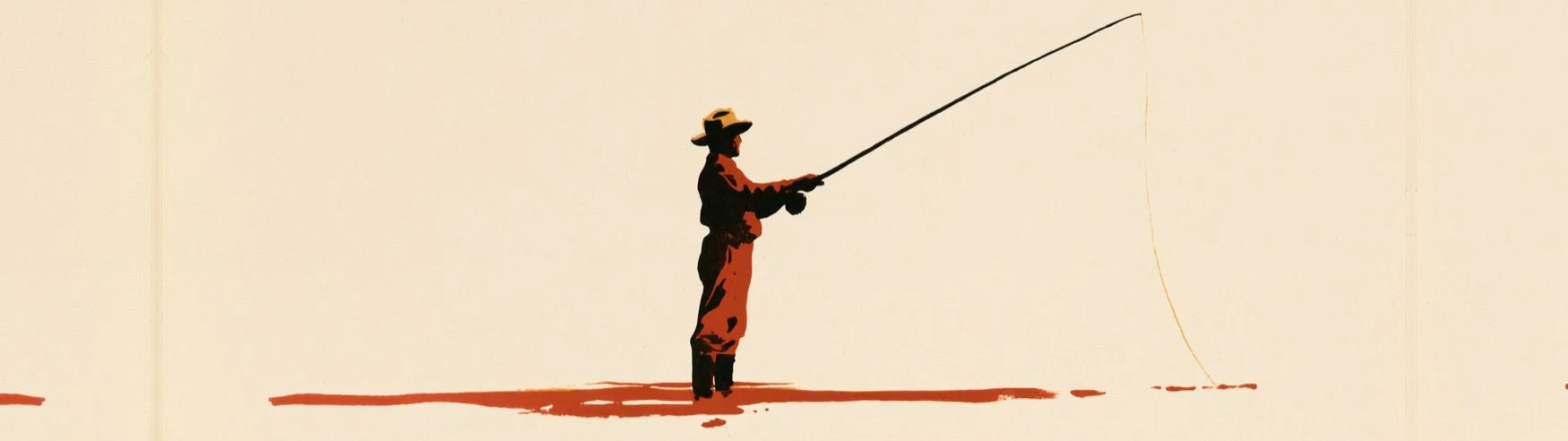

Ask anyone along this stretch of the East Fork about the Carson King and you will get a story: that the family who owned this resort in the 1940s kept exotic chickens for hackle, tied flies in a cabin above the water, and invented a pattern that took the river's name. It is a good story. Parts of it are documented. The part everyone repeats is not.
What follows is what the record actually supports. The fly is real, its recipe is printed, the shop that sold it is named, and it outlived everyone who might have told us who made it.
What the fly is
The Carson King is a dry fly. It is wingless, it wears a collar of brown hackle, it has a tail of golden pheasant tippet, and its body is peacock herl. It has a twin — the Carson Queen — identical in every respect except that its body is yellow floss and its thread is yellow.
Both are tied on a Mustad 94840, which is the standard dry-fly hook. This matters more than it sounds: it means the fly floats. Earlier reasoning here treated the Carson King as a wet fly, and that was wrong.
Nothing in either fly is dyed. Golden pheasant tippet is orange because the bird is orange, and the black bar across it is how the feather grows. Peacock herl is iridescent by structure, not pigment. Brown hackle is brown because the rooster was. Whoever specified these materials was using a bird, not a paint pot.
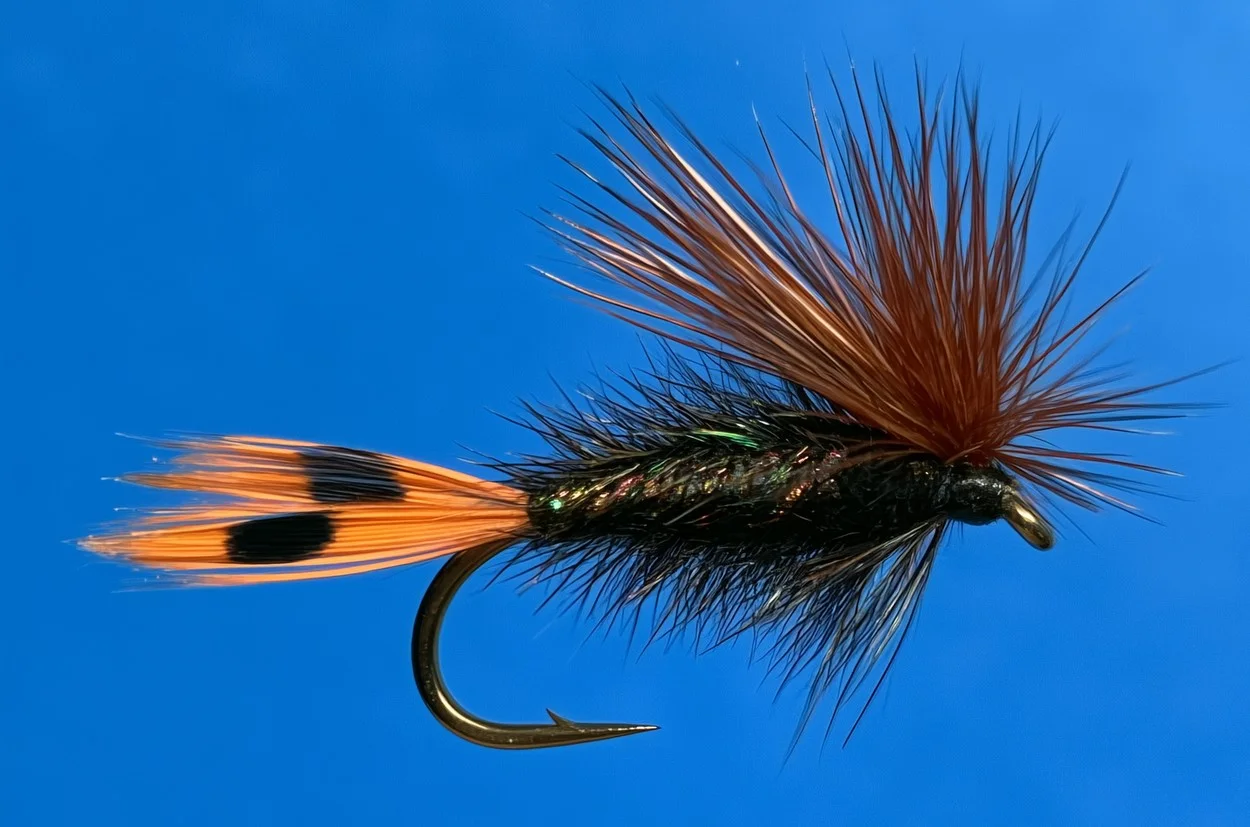
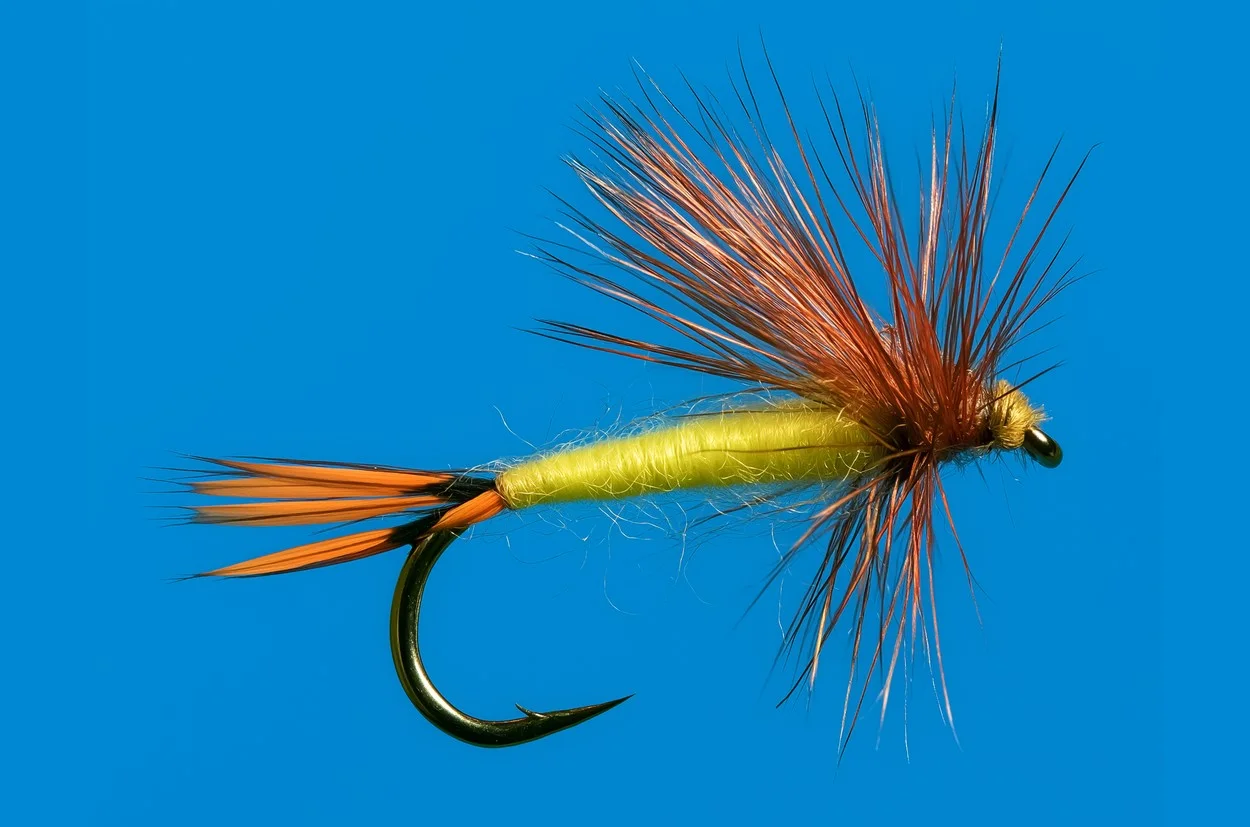
Neither picture above is a photograph of a real fly. No photograph of either pattern is known to exist. What you are looking at was built from the printed dressing and checked back against it line by line — hook, thread, tail, body, no wing, hackle. Everything visible is in the dressing; nothing in the dressing is missing. They are shown as they came off the copy stand, on the plain backdrop they were shot against, because in a page about an exact recipe a cleaned-up picture is a picture you cannot check.
The dressings, as printed
| The Carson King | The Carson Queen | |
|---|---|---|
| Hook | 94840, size 10–14 | 94840, size 10–14 |
| Thread | Black 3/0 mono-cord | Yellow 3/0 mono-cord |
| Tail | Golden pheasant tippet | Golden pheasant tippet |
| Body | Peacock herl | Yellow floss |
| Wing | None | None |
| Hackle | Brown neck hackle | Brown neck hackle |
Appendix entries 101 and 102 of Tying and Fishing the West's Best Dry Flies, Bob Wilson and Rick Parks, Frank Amato Publications, Portland, Oregon, 1978 — foreword by Dan Bailey, ISBN 0936608226. It is not a rare book. It is simply one nobody had thought to look inside for this.
Reading the dressings
The tail is the loud part, and it is the same on both. Golden pheasant tippet — orange, barred black, undyed. It is the first thing a trout sees and the first thing a tyer chooses.
The King's body is the part everybody gets wrong. Peacock feathers are pigmented dark, nearly black. The green is not in the material at all; it is an interference effect thrown off microscopic layers in the barbules, the same trick as a soap bubble, and the black is what makes it visible by swallowing the stray light. So a peacock herl body reads dark, and flashes green and copper only where the light catches it. Dark first. Colour second.
And there is no wing on either. That is the line that places them. A wing would make this a caddis imitation — something pretending to be a particular insect. Wingless, hackle-collared, with a bright tail, it imitates nothing and works anyway. That is an attractor. That is a shop fly. It is what you sell to somebody who is going to fish all day.
What it is a variation of
Four columns to the right, on the facing page of the same book, sit Gray Hackle Peacock and Gray Hackle Yellow — a national standard pair, distinguished from each other by exactly the thing that distinguishes the Carsons from each other: peacock herl for one body, yellow floss for the other.
| Gray Hackle Peacock | The Carson King | |
|---|---|---|
| Hook | 94840, 12–16 | 94840, 10–14 |
| Tail | Red hackle fibers | Golden pheasant tippet |
| Body | Peacock herl | Peacock herl |
| Hackle | Grizzly neck | Brown neck |
Same hook family. Same wingless, hackle-collared construction. Same body pair. What changes is the hackle, grizzly to brown, and the tail, red hackle fibres to golden pheasant tippet.
That is what a local pattern usually is. Somebody took a fly everyone already tied, changed the two materials he had opinions about, and the river's name attached itself to the result. And if the Carson King came out of a household that kept chickens for feathers, a brown rooster neck is exactly the substitution that household would make.
The limit. The book does not say the Carson pair derives from the Gray Hackle pair. That is our reading of two dressings printed on facing pages: an evident family resemblance, not a documented lineage. Strong, and still an inference.
The shop that sold it
Page 105 of the same book is a shop directory, and the Markleeville entry reads: Alpine Bottle & Tackle · Doug Ford · P.O. Box 216 · Markleeville 96120, with his five favoured patterns — Royal Coachman Bucktail, Carson King, Carson Queen, Renegade, Adams.
Three of those are national standards; every shop on that page names flies like them. The Carson King and the Carson Queen are the only patterns on the page named for the water they are fished in, and the only two unique to this shop. The recipes and the shop that sold them are printed back to back on one opened spread — the appendix of dressings runs out at the foot of 104, and the directory starts immediately opposite. One book answers both questions.
The shop stood at Main and Montgomery, and it is attested in local print before the book: a bank's staff profile of Markleeville from about 1970 lists "the Alpine Bottle and Tackle Shop" among the town's businesses — years earlier, from a document that had never heard of the publisher.
The two families
| 1946 | The Whitney family buy the resort — Anthony A. Whitney, his wife Jeannette, the children Mark and Karla Sue, and Jeannette's widowed mother Adelaide Mandell. A household of five, not the four usually cited. |
| 4 April 1950 | The federal census finds them here. Anthony's industry is recorded as "Own Cabins" — the cabin business, in a federal record, in the enumerator's hand. |
| 1950–53 | The gap. Three years in which the two families cannot have met, and after which the town had no fly shop of its own for some time. |
| 1953 | The Ford family arrive from Los Angeles. Lillian Agnes Ford, born at Tyne in England in 1897, would run the Alpine Motel; her son would run the tackle shop. |
| 1978 | The book prints the fly — twenty-five years after Ford arrived in a town he had no prior connection to. |
| June 1984 | William Douglas Ford dies in Markleeville, five years before his mother. |
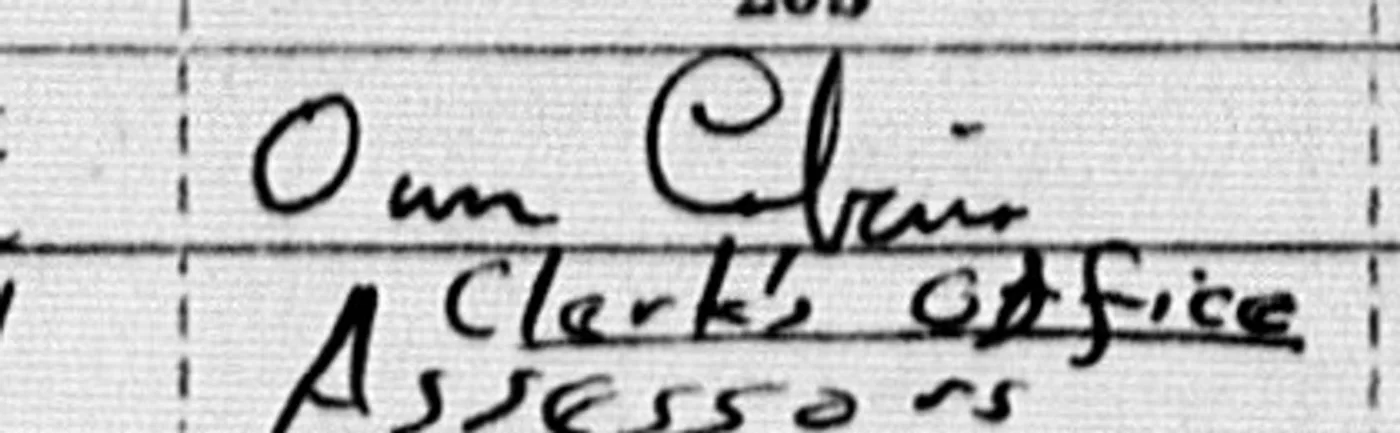
Until that census sheet was read, the only evidence the Whitneys ran cabins on this river was a childhood recollection given seventy-five years later. It is now a federal record, written down in April 1950 by a man walking the highway with a clipboard.
Whoever first tied it, the making is not the part the record kept. What it kept is a pattern still being sold twenty-five years after the second family arrived — a fly that had already outlasted the first.
The fly carries this river's name, and it outlived the people who fished here before us.
Why it is called a King
"King" is not a flourish on the end of a name. It is a recognised class of American dry fly, and the convention runs back to the nineteenth-century King of the Waters and its partner Queen of the Waters — the same royal pairing, distinguished by the colour of the body. A Carson King with a Carson Queen beside it is a form being used correctly, by somebody who knew the form.
The same 1978 book carries other Kings — the Rio Grande King is in the same appendix, and the Colorado King is photographed twice, once in colour, with its creator named and quoted. The Carson King got six lines in an appendix and a mention in a shop's top five. The difference is not quality. It is that somebody wrote to the man who made the Colorado King and got an answer, and nobody did that for whoever made ours.
How we know it
Everything here was read at the original page image rather than from machine-transcribed text. These are old documents, scanned, set in narrow columns. Software that converts them to text reads the characters correctly but not the page, and stitches neighbouring columns into sentences that are fluent, plausible and wrong. The result never looks like an error. It looks like a fact.
Twice it looked like a fact here. The Carson King was first reported as belonging to a tackle shop in Visalia, four hundred miles away, and the contradiction with Markleeville was written up as a genuine puzzle. It was not: the Markleeville entry gives a P.O. box, and two columns to its right another shop gives a street address. The transcription had fused the columns and moved the fly four hundred miles. Separately, Lillian Ford was recorded here as running the "Alpine Hotel" — a word copied from a summary rather than checked. The page reads Motel, and an Alpine Motel is independently attested in the same archive.
So the working rule, on this page and everywhere else on this site: a transcript, a summary or a careful note is a lead. The page image is the source. Where we cannot read the image, we say so rather than filling the gap.
If you want to tie one
A 94840 hook, black or yellow thread, golden pheasant tippet, peacock herl or yellow floss, and a brown neck hackle. Five things any fly shop still stocks. The dressings constrain the materials and say nothing about proportion, how heavily the hackle was wound, or how long the tail ran — those are ordinary tying practice, which is to say a guess made by somebody who was not there.
If you tie one and fish it here, bring it by the store. The object that would settle the most is a tied one, and we would like to photograph a Carson King that somebody actually made.