

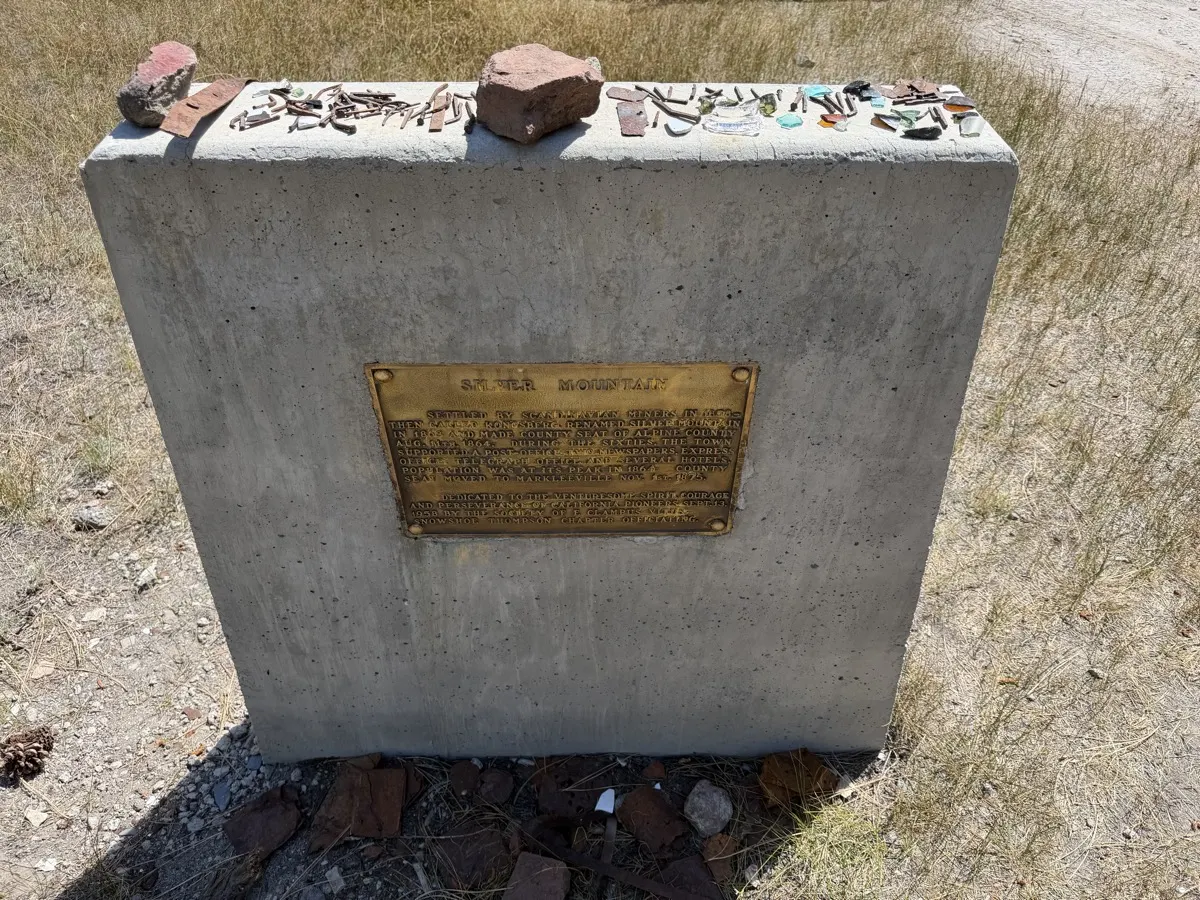
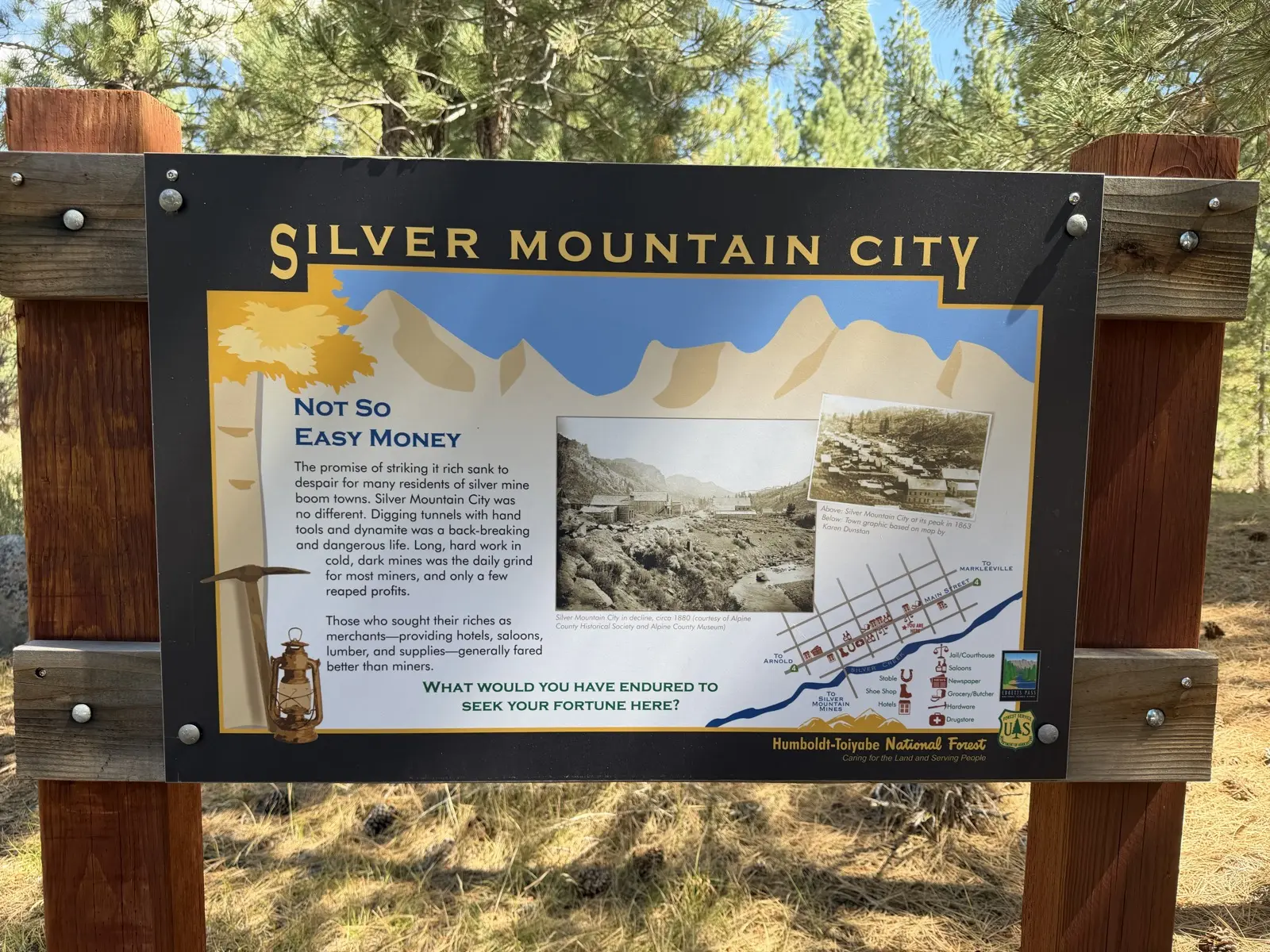
It started with Scandinavians. In 1858, prospectors settled a camp on today's Highway 4 below Ebbetts Pass and named it Kongsberg, for Norway's silver town. A rich strike in 1863 set off the rush; the camp was renamed Silver Mountain, and at its peak it held some 3,000 people, a post office, two newspapers, express and telegraph offices, and several hotels.
The fever was enough to build a county. On March 16, 1864, Alpine County was created from parts of Amador, Calaveras, El Dorado, Mono, and Tuolumne counties, with Silver Mountain City as its seat and a population claimed at around 11,000. Markleeville, the upstart town by the creek, counted 168 houses, a telegraph line from Genoa, and 2,620 people.
Markleeville's founder never saw any of it. Jacob Markley staked his 160 acres and toll bridge on September 12, 1861 — and on May 14, 1863, he was shot dead outside his own cabin by Henry W. Tuttle, in a quarrel over whether a half-interest Markley had sold covered the land or only the toll road. A jury acquitted Tuttle on self-defense. The Alpine County Courthouse, built in 1928 of stone quarried above Silver Mountain City, stands today on the very claim Markley staked.
The trouble was the ore. Alpine's silver came bound up in antimony-arsenic sulfosalts — "rebellious" rock that resisted the amalgamation process making the Comstock rich next door. Long tunnels never paid for themselves, and some ore was shipped for smelting as far as Swansea, Wales.
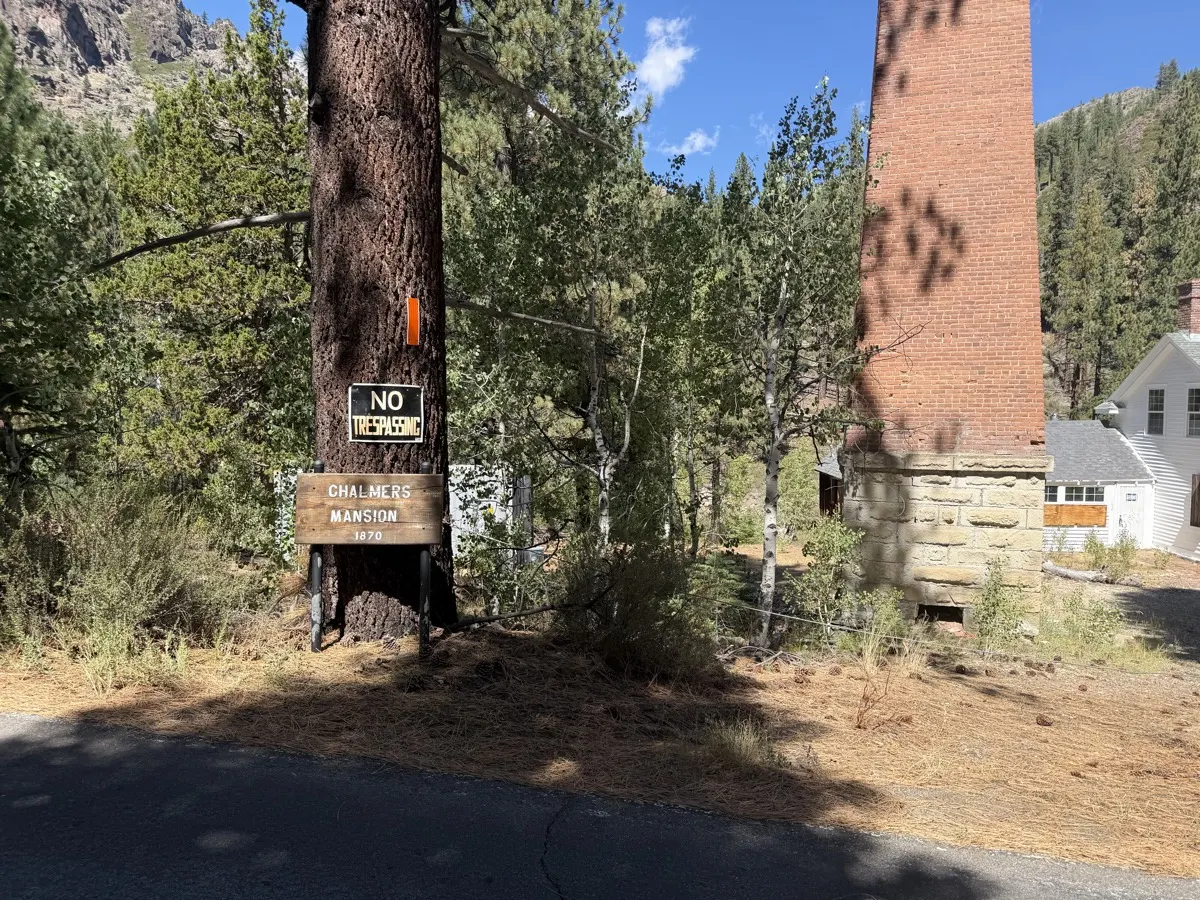
Nobody stayed with it longer than "Lord" Lewis Chalmers, the Scot who arrived around 1866 with London money, drove the Imperial tunnel 1,406 feet into Mount America without finding pay ore, and kept British capital flowing into hopeless mines for nearly two decades. He sailed home to raise fresh funds around 1884 and died in London in 1904, never having returned. His wife Nettie, the story goes, walked to the stage stop every day for nineteen years, waiting.
The bust is plain in the numbers. By 1868 the county's population had fallen below 1,200; the 1870 census counted 685, and the 1880 census 539. The total recorded output of the Silver Mountain district was about $200,000 in gold and silver, against millions invested, and the 1873 demonetization of silver finished it.
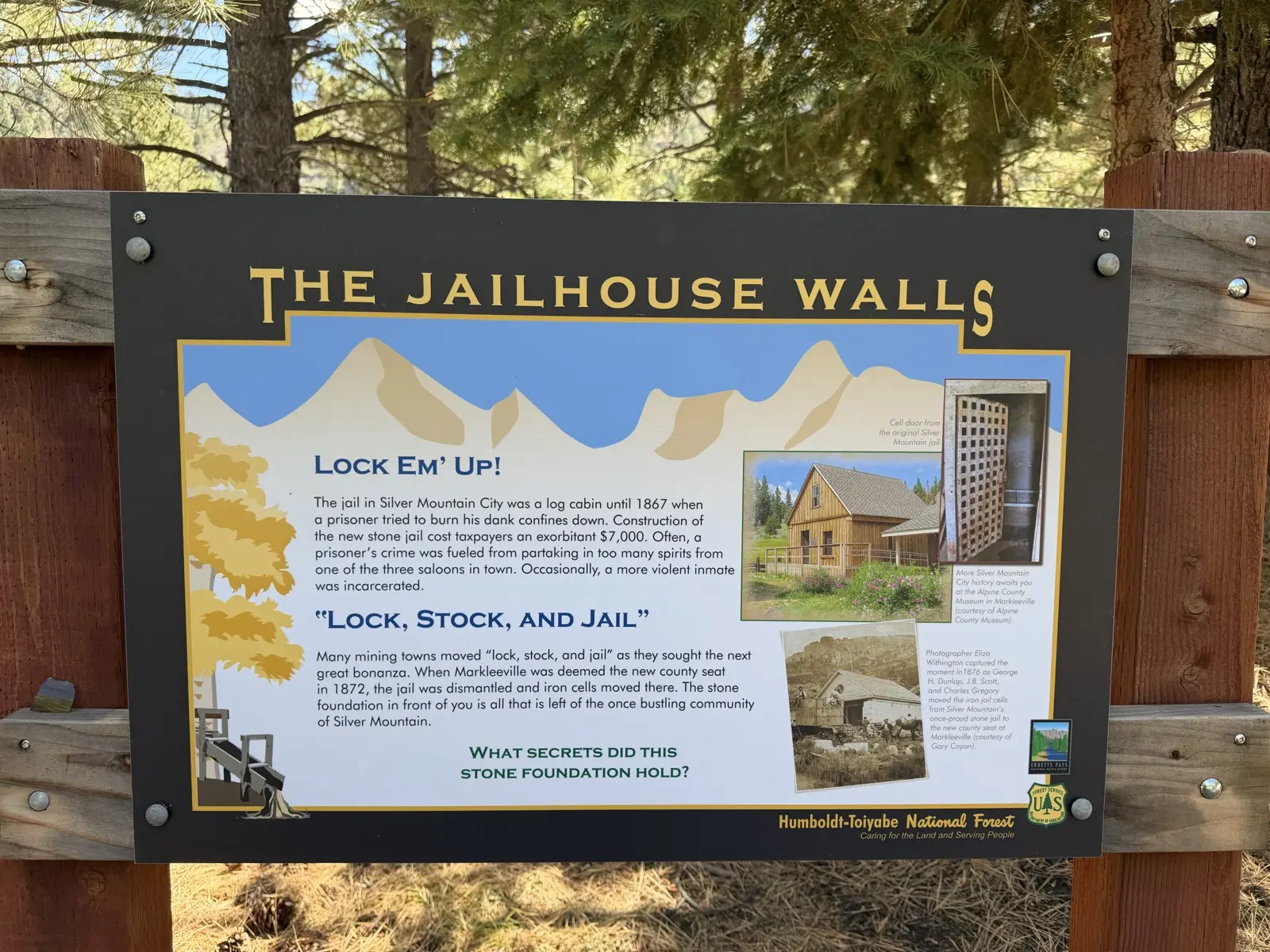
In 1875 the county seat moved to Markleeville. In 1878 the Bodie strike emptied what was left, and the Alpine Chronicle — billed as the first newspaper on the Sierra's east slope — loaded its press and followed the miners out of the county. Fire took most of the remaining town in 1882.
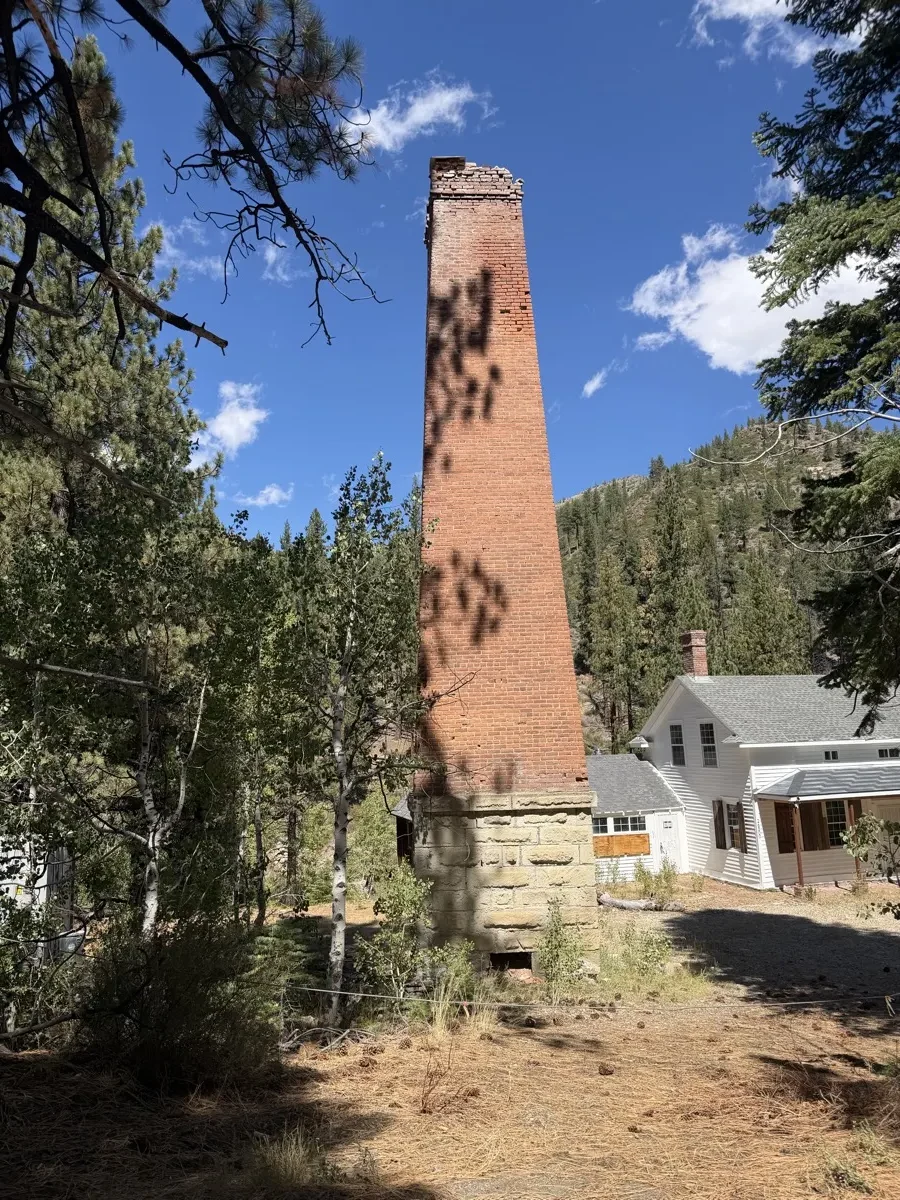
A good deal of it is still standing. Up Highway 4 are the granite ruins of the jail, the Chalmers Mansion, and an 1862 brick smelter chimney alone in the sagebrush. In Markleeville you can drink inside the 1862 Fiske House, hauled board by board out of the dying Silver Mountain City in 1886 and rebuilt as a hotel — today's Cutthroat Tavern, the oldest building in town.
The county that silver built and then abandoned is the quietest in California now. A fishing resort has kept one bend of it since 1920.