
In December 1872 — some retellings say 1873 — a Silver Mountain City man named Ernst Reusch shot a saloonkeeper named Erickson; an 1891 paper calls him Eric Erickson, a Swede. Alpine County, cash-poor in the bust years, arranged to move Reusch to Mono County for trial rather than pay for one at home.
He never got there. On April 17, 1874, masked vigilantes stopped the escort at the East Carson bridge, noosed Reusch, and dropped him over the side. No one was ever charged. The papers of that spring called the crossing Johnson's Bridge, or the old toll bridge; by 1889 the federal survey was labelling it Hangmans Bridge, and the name has stuck. The E Clampus Vitus marker at the site, first placed in 2014 and rewritten by the Snowshoe Thompson Chapter in 2017, tells the story.
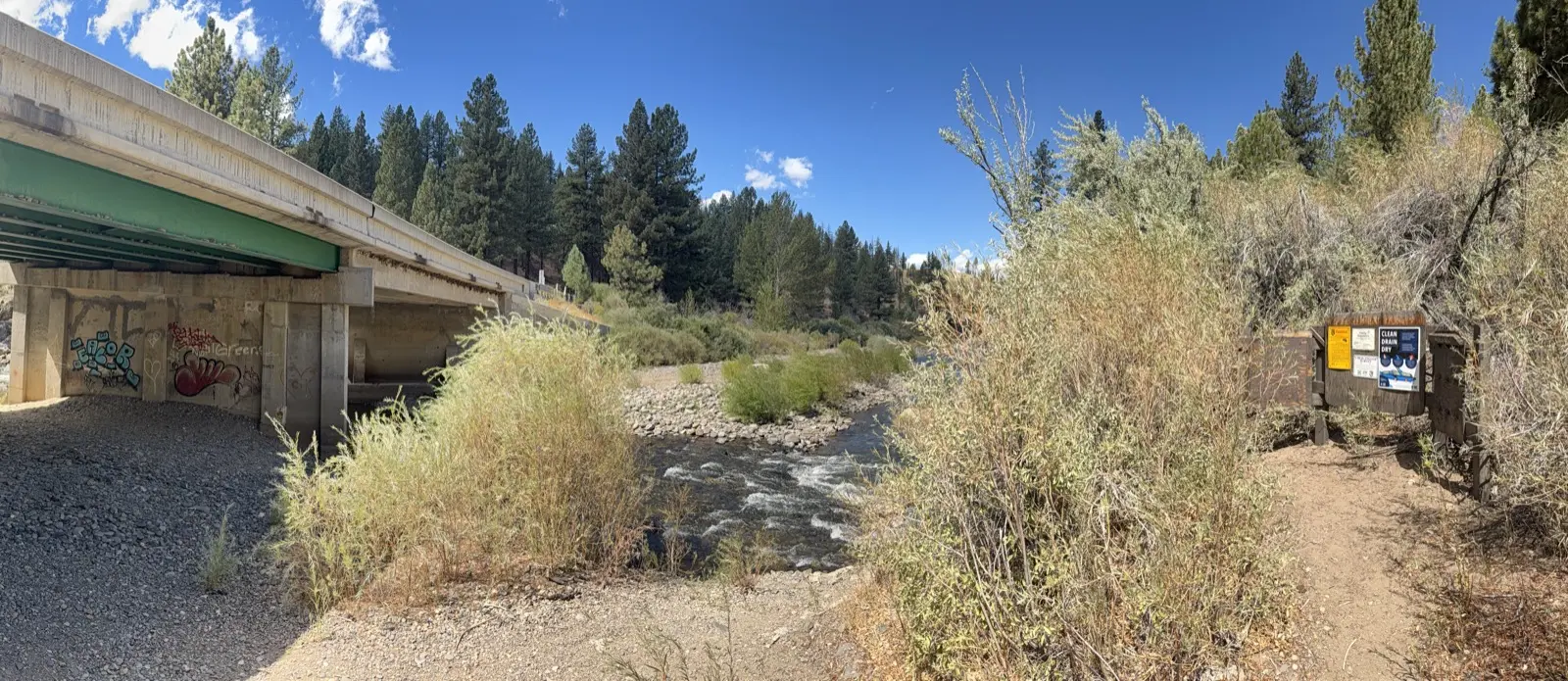
Today's Highway 89 span stands at or near the crossing of the old Johnson toll road, built for the silver traffic. A 2014 plaque put the lynching bridge a mile upstream of it; the same chapter dropped that line when it rewrote the marker in 2017, and the 1889 federal survey draws a single crossing on this reach, already labelled Hangmans Bridge. Either way, it is the resort's nearest named landmark, about a mile downstream of the cabins.
From Hangman's Bridge the East Fork runs roughly ten miles to the Nevada line with no dam and no road, which was not the plan. The federal Washoe Project authorized a dam on this reach in 1956, and a 1962 plan priced the Watasheamu Dam at $23 million with a reservoir backing nine miles into California. It was never built, and by the mid-1980s the economics had killed it for good.
On July 26, 1989, California added the East Fork from Hangman's Bridge to the state line to its Wild & Scenic Rivers System, and BLM has since found another four and a half miles of the East Fork eligible for the national system.
Below the bridge the fishing rules change. The canyon is special-regulation water: open all year, artificial lures only, a 14-inch minimum, two-trout limit. The reach carried the state's Wild Trout Water designation until the Fish and Game Commission struck it from the list in the 2020–21 overhaul. A separate Wild Trout reach above the Wolf Creek confluence was designated in its own right and was not affected. Those special regulations still stand.
Rafters put in at the bridge for a roughly twenty-mile Class II wilderness run with one bigger drop, named Sidewinder — American Whitewater rates it II+, and the commercial outfitters call it Class III. It is usually done as an overnight in the snowmelt season, roughly April through June. A riverside hot spring on the run has reported post-fire mudflow damage, so ask an outfitter about its condition before you count on it.
Above the bridge — the resort's stretch — is the stocked, family-friendly water under general statewide rules. The Fishing page covers both sides of the crossing.
The bridge is a mile downstream of the resort on Highway 89.