
The bear
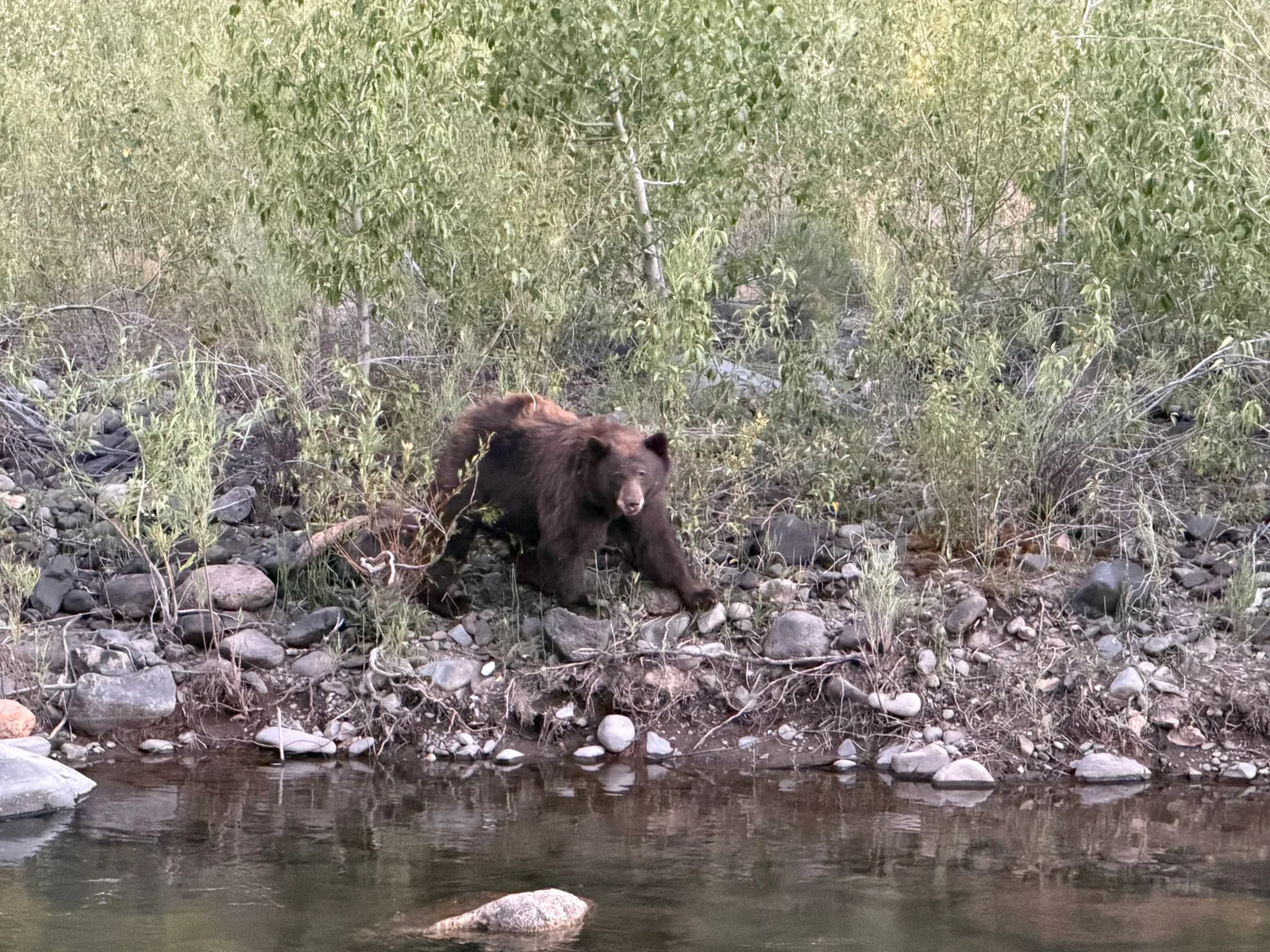
The bear on this page is not a stock animal. It is a black bear with a cinnamon coat — common here, and nothing to do with brown bears — working the resort's own bank of the East Fork, filmed by the owner in August 2026. It works this property through late spring and summer, which is when you would have a chance of seeing it. It is also the largest animal anyone has provably filmed on that bank — though the ridge across from campsite 4 has its own claim to the contrary, a quarter-million views strong.
Black bears are the only bear in California. The state's grizzlies are gone, and the one on the flag has been extinct here for a century. What that means practically is that the animal you may see is a large, strong, food-motivated opportunist that would rather leave than meet you.
Store food. Not in a cooler on a picnic table, not in a tent, not in a car footwell where it can be seen. Grover Hot Springs State Park, twelve minutes up the road, currently carries a standing "bears are active" alert and requires food and scented items to be stored in its lockers day and night — that is the neighbourhood, and it is the same bears.
The deer are on a migration older than the state
The Carson River mule deer herd is an interstate herd. It summers in Alpine County's high country and winters down along the California–Nevada line, and it has been making that crossing since long before there was a line to cross.
Between 2012 and 2019 the California Department of Fish and Wildlife collared animals from this herd and mapped the corridors it actually uses. The study found the herd down more than seventy per cent from its historic peak — habitat loss and vehicle strikes, mostly.
They range over the resort itself, not just the ridges above it. So when a deer crosses the highway in front of you here, it is not wandering. It is on a route, and the route is in trouble.
The beaver, and what was under the meadow
For most of the twentieth century the settled position was that beaver were not native to the Sierra Nevada. Two zoologists set it — Joseph Grinnell in 1937 and Donald Tappe in 1942 — and they drew the line hard: no beaver historically above 1,000 feet on the western slope, and none at all on the eastern slope. This river is on the eastern slope. Under that ruling the beaver here were categorically foreign, and state policy followed, because an introduced animal can be removed. Beaver were then deliberately stocked into the range anyway, from the 1930s — the Tahoe Basin animals came from the Snake River in Idaho, which is where the "they were put here" story comes from.
Then a creek cut down through a meadow and exposed what was buried in it.
In 1988, erosion on Red Clover Creek in Plumas County uncovered beaver dams that had been under four feet of soil. The wood was interlaced and it carried beaver cut-marks — the acute-angled cuts a beaver's teeth leave. Three samples from one dam came back AD 580, AD 1730 and AD 1850, each within sixty to seventy years. Read with the soil profile: built around 580, still in use and repaired around 1730, a major breach repaired around 1850, then abandoned and buried.
Not continuous tenancy — the authors' own word is periodic, a dam occupied on and off for more than a millennium. And that last repair lands where the authors note it lands: at the peak of the nineteenth-century fur trade, when the Hudson's Bay Company was deliberately trying to trap the West's beaver out to make a "fur desert."
Buried dams have since been found in the Carson watershed, along with the Mokelumne and other Feather River meadows. They have not been dated. Nobody has done the work here yet.
Two honest caveats, because this is a live argument and not a settled one. The physical evidence is northern-Sierra evidence — Plumas County, not this county. And a 2021 paper by ten authors, several of them US Geological Survey, attacks the wider case for native beaver in California as resting on place-names and newspaper items rather than physical proof. That paper is about coastal southern California; it does not cite the radiocarbon work and never mentions dating at all. The dam wood stands unchallenged. The argument around it does not.
California settled its side in law regardless: a 2024 statute now declares the beaver "a keystone species that is native to California," and the state began releasing beaver into Sierra watersheds in 2023 for the first time in about seventy-five years.
What else is here
Bald eagles nest nearby and fish this stretch — they live here, they are not passing through. River otter are present. So are mountain lion, bobcat and coyote, in the way those animals are always present and almost never seen.
Higher up, two species are in the kind of trouble that gets measured. The Sierra Nevada yellow-legged frog was listed as endangered in 2014 after a decline of about ninety-five per cent; the population at Highland Lakes, near Ebbetts Pass, is now a source — animals from it are being moved into the Carson-Iceberg, and it is showing real recovery against the chytrid fungus that caused the collapse. The bi-state sage grouse, a genetically distinct population whose range includes this county, has a nearby subpopulation in the Pine Nut Mountains down to roughly thirty-three birds.
And the aspen are one animal
The groves that turn gold on Monitor Pass are not stands of individual trees. Each grove is a single clonal organism — one root system underground, many trunks above it, every trunk genetically identical to every other.
So a hillside that goes gold in a week while the next one stays green is not answering the weather. It is one plant changing colour, and the hillside beside it is a different plant. The Monitor Pass page has the road and the fortnight to drive it.